Showing posts with label Whisky. Show all posts

Sunday, 11 March 2012

Ballantine’s Draws on its Inner Depths with New Signature Distillery Editions

Ballantine’s, the No 1 ultra-premium Scotch whisky in Asia Pacific, is set to unveil two Signature Distillery Editions of Ballantine’s 17 Year Old – part of a new four-strong collection of innovative whiskies that highlight the influence of the signature malts that provide the depth to Ballantine’s 17 Year Old.

Specially created by Master Blender Sandy Hyslop, each limited edition aims to showcase the unique contribution of one of four distilleries – Scapa, Glenburgie, Miltonduff and Glentauchers – by accentuating their characteristics within the limited edition blend.

Ballantine’s 17 Year Old Signature Distillery Scapa Edition is a 43% ABV blended Scotch that dials up the influence of Scapa, the single malt that gives Ballantine’s 17 Year Old its rich, sweet top dressing, while contributing to the initial burst of fruity, floral flavours. As a result, this whisky is bursting with a zesty, fruit sparkle of sweet orange and peach flavours but remains incredibly smooth, creamy and luxurious.

Ballantine’s 17 Year Old Signature Distillery Glenburgie Edition is a 43% ABV blended Scotch that highlights the influence of Glenburgie, the single malt that sits at the heart of the Ballantine’s blend. Located in Speyside and surrounded by temperate and fertile terrain, Glenburgie distillery produces a fruity, floral and rich-flavoured malt. As a result, this limited edition provides smooth aromas of apples and blackcurrants with a honeycomb sweetness whilst maintaining the soft, elegant and balanced style of Ballantine’s.”

Sandy Hyslop, Ballantine’s Master Blender, says: “Ballantine’s 17 Year Old is a blend of more than 40 different malt and grain whiskies from all over Scotland, but Scapa, Glenburgie, Miltonduff and Glentauchers stand out as having played a monumental role in the blending process of our master blenders over the years. These stunning limited editions offer the whisky drinker an insight into blending and the role that these malts play in the original and much-celebrated Ballantine’s 17 Year Old blend.”

Ballantine’s 17 Year Old Signature Distillery Scapa Edition will be available in limited quantities in Korea while Ballantine’s 17 Year Old Signature Distillery Glenburgie Edition will be available in limited quantities in duty free. The range is priced from RRP 69 USD in Asia Duty Free.

About Ballantine’s
Ballantine’s is the No 1 ultra-premium Scotch whisky in Asia Pacific and the range sells over 70 million bottles a year worldwide. Ballantine’s has won more than 80 trophies and medals at international competitions in the past 10 years for quality, as a result of its unique richness of character and perfect balance. The range, from Ballantine’s Finest to the iconic 30 Year Old, is the most extensive in the world of Scotch and is maintained by the latest in a tradition of Master Blenders that dates back to 1827.

Saturday, 3 December 2011

Brandy and Whiskey.. What’s the difference?

While Cognac is made from grapes (the brandwijn), Whiskey is made from grains. Both are fermented, and convert sugar to ethanol. One thing that whisky and cognac have in common is that they are aged in barrels: They get more and more smooth. The spirits pick up quite a lot from the wooden barrels: Color and taste of course. And scotch and cognac share the method of distillation in pot stills. Both spirits are distilled at low proof.
Whiskies and Cognac
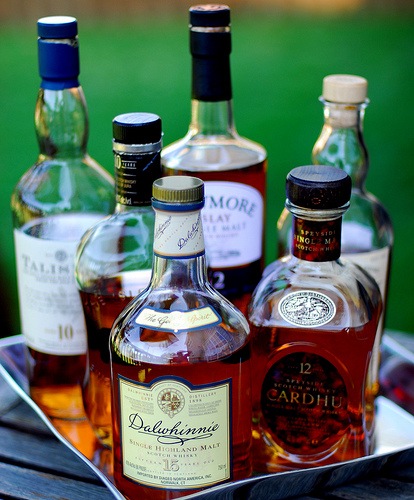
Whisky
Grapes vs. grains
But let’s be honest: There are quite some differences between whiskey and brandy. It begins with the raw materials, over methods and how to consume the actual product.
Whiskey is made from grains, normally barley. That is then mixed with water and yeast, then it gets distilled. The spirit then is aged in oak barrels.

Now what is the difference between Whiskey and Whisky? One word with the “e” and the other one without it. The spelling referrs to the location of distilling: Whisky comes from Scotland, Japan or Canada – and whiskey comes from Ireland and the United States.

The name “brandy” comes from Dutch “branwijn”, burnt wine. And that is quite a good name, as wine is distilled for brandies and of course Cognac.

The raw material of cognac is grapes: A juice is fermented and we get a very acid wine as a result – perfect for cognac production. The juice is fermented about 5 days before distilling, after a double distillation process, the eaux-de-vie is stocked in oak casks.
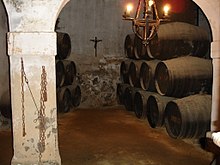
Brandy barrel ageing
What about age? Is Cognac older than Whiskey?
Both Cognac and Whiskey is aged in casks. The age of brandies can be below three to six years, and Cognac at least 2 1/2 years. Most of the brandies are below six years, but can also be a hundred years old.

While cognac and brandy uses age terms such as VOP, VS, VSOP or XO, Whiskey shows the exact age of its content: for example 3, 5, 10, 12 or 15 years. There are also Whiskies at 18 years, but older seems to be rare and pricey.
XO Excellence Premier Cru
Rémy Martin XO Premier Cru
While brandy is seen as a digestif, after dinner spirit – perhaps with some coffee – Whiskey doesn’t have such an “old” and “conservative” image, and is also consumed in bars or nightclubs. Cognac is about to (re)become more and more a cocktail drink. Even when it used to be an important cocktail ingredient some time ago.

The Macallan 18 year Whiskey
Regarding the drinking: You may drink a whiskey with water, some people think you would never add water to brandy, even when it was done hundreds of years ago. Why? Because Cognac is made from fruits and Whisky from grains – that means it has a different structure. I'm not sure if that’s true, at least it’s just an opinion.
There are also Cognacs where you can add a spash of water.

So, brandy and whiskey differ in quite some points.

And what is the difference between a brandy and a cognac? Well…  all Cognac is brandy, but not all brandy is Cognac.
Related Posts Plugin for WordPress, Blogger...