The Legend of Ice Wine
Legend has it that ice wine was discovered by a German winemaker who was away from his vineyard during harvest (never a good idea), and when he returned all of his grapes had been frozen on the vine. Undeterred he carried out the unorthodox harvest as usual and proceeded to press his frozen grapes for fermentation. The result, the first eiswein!!!
Icewine, or Eiswein, originated in Franconia, Germany in 1794. However, Canada has got the current claim to ice wine-making fame, with the majority of the market's ice wine offerings coming from British Columbia. Grapes were left on the vines until the first deep frost, and the freeze/thaw cycles that occurred concentrated both the sugars and flavors of the grapes.
 |
| Ice wine is made from frozen grapes |
The process was refined, and now icewines are highly prized drinks that are created in Germany, Austria, and Canada. The Niagara region of Ontario, Canada is currently the most widely respected producer of ice wines.
German eiswein is a Qualitätswein and falls under those rules. In Canada, the ice wine is governed by the Vintners Quality Alliance.
Canadian Ice wine, properly created, must follow VQA (Vintners Quality Alliance) regulations to ensure a quality product. Key amongst these rules is that the wine must be naturally produced - no artificial freezing allowed. This makes ice wine very difficult to create - grapes must be guarded against too extreme temperatures, and because they are the last grapes on the vines, they must be defended vigorously against birds and other animals.
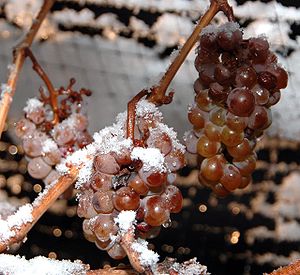 |
| Freezing of grapes caused the sugar level to be concentrated |
As in all harvests, the exact moment of harvest is extremely important for ice wine. Ideally the temperature should get to -10°C to -13°C before picking. This provides the optimum level of sugar and flavor in the grapes. This chart shows how sugar varies with the temperature:
Sugar Levels
| Temperature | Sugar Content |
| -6°C | 29% |
| -7°C | 33% |
| -8°C | 36% |
| -9°C | 39% |
| -10°C | 43% |
| -11°C | 46% |
| -12°C | 49% |
| -13°C | 52% |
| -14°C | 56% |
When the grapes are just right, they're carefully picked by hand. Grapes in this condition have a very low yield - often an entire vine only makes a single bottle. That's why ice wine can be so expensive and is often sold in half-bottles only ... but it's worth it!
 |
| Ice wine: mostly made from Riesling and Vidal grapes |
What Grapes are Used in Ice Wine?
The most common grapes utilized in the making of ice wine are Riesling, Vidal, Gewurztraminer and Cabernet Franc - grapes with higher levels of acidity to render the final wine refreshing and not heavy or overly "sticky." However, as is common in the wine industry there are plenty of winemakers experimenting with a variety of grapes in a variety of regions to stretch the limits and discover new twists on this famous form of wine.
After long harvest process, the grapes go through weeks of fermentation, followed by a few months of barrel aging.
The wine ends up a golden color, or a deep, rich amber. Most ice wines are made in a medium to full-bodied style. The most common aromas tend towards the stone fruits, with apricot and peach being the top components of aromatic character in the ice wines made from white grape varietals. On the palate, sweet, honey-like nuances shine bright along with the replay of stone fruit and rich, exotic flavors of tropical mango. Red wines tend towards strawberry and candied red fruit profiles with sweet spicy aromas woven in the mix.
 |
| Fiori Vidal Blanc Ice Wine |
Inniskillin is perhaps the most well-known producer of Icewine, and for good reason. As Canada's premier producer of Icewine they have created quite a reputation of quality-driven and surprisingly accessible Icewines. There are up and coming producers of ice wines in many regions of the world. In the U.S., the Pacific Northwest, New York and Michigan are maximizing their climate zones to put their grapes to use in making ice wines when the seasons cooperate. Others are artificially freezing grapes post-harvest to emulate the process of making ice wines, though the results are not as stunning as those made from naturally frozen grapes.


